
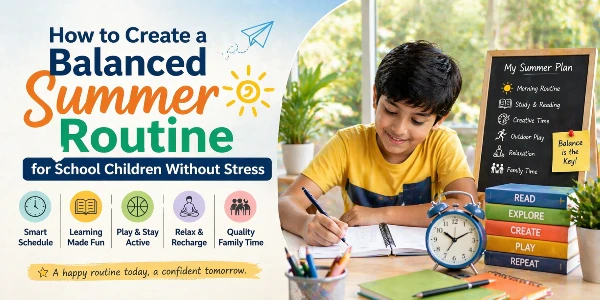
How to Create a Balanced Summer Routine for School Children Without Stress
A Typical Summer Day… That Slowly Goes Off Track
It usually starts like this.
“Let them relax — it’s summer.”
The first few days feel easy.
Children wake up late, spend time watching TV, play on their phones, and enjoy the break they’ve been waiting for.
No pressure. No rush.
But somewhere after a week or two, things begin to shift.
Sleep cycles become irregular.
Screen time quietly takes over.
Books stay untouched.
And boredom starts replacing excitement.
Parents begin to notice the change, but by then, bringing structure back feels difficult.
That’s when the real question comes in:
How do you create a routine… without turning summer into another school schedule?
The Real Problem Isn’t Free Time — It’s Directionless Time
Children don’t struggle with having time.
They struggle when time has no direction.
When days are completely unplanned, children naturally move toward the easiest form of engagement — screens.
Not because they prefer it.
But because nothing else is structured enough to replace it.
This is why many parents search for:
how to keep kids productive during summer holidays
summer routine for school children
healthy daily habits for students
What they are really looking for is balance — not control.
Routine Should Feel Light, Not Forced
A summer routine should not look like a timetable pinned on the wall.
If it feels rigid, children resist.
If it feels natural, children follow.
Instead of planning every hour, think of the day in zones rather than schedules.
A day that flows is far more effective than a day that is controlled.
Rebuilding the Day — Without Saying “Follow This”
Here’s a simple way to look at it.
Not as rules.
But as rhythm.
Morning: Reset the Mind
The way a child starts the day matters more than what they study.
If mornings begin with screens, the entire day becomes passive.
Instead, a calm and light start works better:
Reading a story
Solving a puzzle
Writing a few thoughts
Even helping with small tasks
This is where consistency begins.
Parents often underestimate this — but morning habits for children directly influence focus and discipline.
Midday: Let Curiosity Take Over
This is the best time to introduce learning — but without calling it “study.”
Children don’t resist learning.
They resist the feeling of being forced.
So instead of textbooks:
Let them explore something new
Let them try something creative
Let them ask questions
It could be art, music, storytelling, simple experiments, or even watching something meaningful.
When learning feels optional, children engage more deeply.
Afternoons Are Not “Wasted Time”
Many parents worry when children “do nothing.”
But unstructured time is not always negative.
It is where imagination builds.
It is where children:
Think
Create
Reflect
Relax
In fact, constant activity can be just as harmful as no activity.
Balance means allowing space.
Evenings: Where Energy Finds Direction
Children naturally have high energy in the evening.
If this energy is not directed, it goes into screens.
If it is guided, it becomes growth.
Outdoor play is not just physical activity — it supports:
Confidence
Social skills
Emotional balance
Even simple activities like cycling or playing in a park can make a huge difference.
Parents searching for healthy habits for kids during summer often overlook how powerful this time is.
The Screen Time Conversation (That Always Turns Into an Argument)
Every home has this moment.
“Stop using the phone.”
And the response is usually resistance.
The problem is not screens.
It is lack of boundaries.
Instead of reacting daily, define expectations clearly:
When screens are allowed
When they are not
What type of content is okay
Children follow consistency better than instructions.
One Section That Actually Needs Structure
There is only one place where a little structure is necessary — growth activities.
These are not compulsory, but they should be consistent.
You don’t need many.
Just one.
A skill
A hobby
A practice
Something that the child sticks to.
Because this is where discipline quietly develops.
What Parents Often Get Wrong
The intention is always right.
But the approach sometimes creates pressure.
Trying to make children “fully productive” during summer can backfire.
Children don’t need a perfect routine.
They need a realistic one.
A routine where:
They don’t feel judged
They don’t feel rushed
They don’t feel compared
Consistency matters more than intensity.
The Shift That Changes Everything
Instead of asking:
“Did you study today?”
Try asking:
“What did you do today that made you feel good?”
This shifts the focus from performance to experience.
And when children enjoy the process, discipline follows naturally.
As School Reopens — The Hidden Advantage
Children who follow a balanced summer routine don’t struggle when school resumes.
They adjust faster.
They feel more prepared.
They don’t experience sudden stress.
Parents looking for how to prepare kids for school after holidays often realise that preparation doesn’t begin at the end — it begins with how summer is managed.
Conclusion: The Goal Is Balance, Not Perfection
Summer is not meant to be structured like school.
But it also should not become completely unstructured.
The real goal is simple:
Create days that feel free — but not lost.
A balanced routine helps children:
Stay active
Stay curious
Stay connected to learning
At Johnson Grammar School, L.B. Nagar and Kuntloor, Hyderabad, the focus on balanced development and structured learning during the academic year helps students naturally carry discipline into their daily lives — even during holidays.
Because when children learn how to manage time without pressure, they don’t just build routines.
They build independence.