
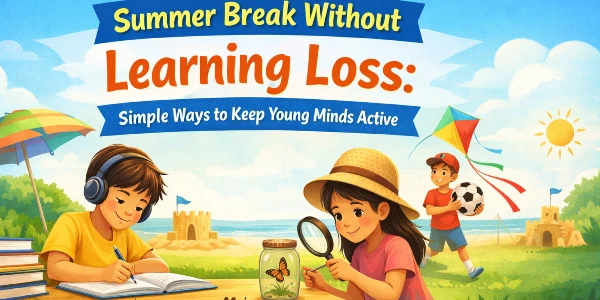
Summer Break Without Learning Loss: Simple Ways to Keep Young Minds Active
Summer break is something every child looks forward to — and rightfully so.
Two months of freedom from structured school hours, heavy bags, and exam pressure. For children, it is a time to relax, explore, and simply be themselves.
But for parents, summer often brings a quiet concern:
“Will my child forget everything they learned this year?”
This concern is valid. Many studies show that children can lose a noticeable portion of their academic skills — especially in reading and mathematics — during long, unstructured breaks. This is commonly called the “summer slide.”
The good news? Preventing it doesn’t require turning summer into another school term. It simply requires keeping young minds active, curious, and engaged in natural ways.
What Is the Summer Slide — And Is It Real?
Yes, the summer slide is real.
It refers to the learning loss that happens when children stay away from structured learning for a long period. Skills that took months to build can weaken within weeks if they are not used regularly.
The most affected areas usually include:
Reading fluency and comprehension
Mathematical accuracy and speed
Vocabulary development
Writing habits and expression
For younger children, especially between Class 1 and Class 5, the impact can be more visible because foundational skills are still developing.
But the solution is not pressure. It is consistency in thinking.
How Much Learning Loss Happens During Summer?
Many parents are surprised by how quickly learning gaps can appear.
Students can lose up to two months of reading progress, and mathematical skills tend to decline even faster because they require regular practice.
When school reopens, teachers often spend the first few weeks revising old concepts instead of moving forward.
For students in ICSE schools — where learning is deeper and more structured — starting behind can create unnecessary pressure early in the academic year.
The key takeaway is simple:
Even small, consistent engagement during summer makes a big difference.
Does Summer Break Need to Be Educational to Be Valuable?
Not at all.
This is one of the biggest misconceptions parents have.
Rest is not harmful — in fact, it is necessary. A child who feels refreshed returns to school with better focus and energy.
The goal is not to replace school. The goal is to keep the habit of thinking alive.
There’s a clear difference between:
A child who reads one book for enjoyment
A child who is forced to complete daily worksheets
The first develops interest, imagination, and language.
The second may develop resistance toward learning.
Enjoyment sustains learning better than pressure.
Simple Ways to Keep Young Minds Active During Summer Break
These are practical, low-pressure, and effective ways parents can follow without turning summer into a routine-heavy schedule.
1. Encourage Daily Reading — Let Them Choose
Reading is the most powerful way to prevent learning loss.
It improves vocabulary, comprehension, imagination, and writing — all together.
Let children choose what they want to read:
Storybooks
Comics
Adventure novels
Science books
Mythology
Even 20 minutes a day is enough to maintain reading skills.
2. Cook and Bake Together
Cooking is a natural learning experience.
It involves:
Measurements (Math)
Instructions (Reading)
Experimentation (Science)
Children enjoy the process — and the outcome.
This makes learning practical, engaging, and memorable.
3. Explore the City Through Real Experiences
Hyderabad offers many educational experiences beyond classrooms:
Science museums
Historical sites
Zoos and parks
Cultural landmarks
When children see and experience things directly, learning becomes meaningful.
A simple question like
“What did you find interesting today?”
can turn a visit into a powerful learning moment.
4. Encourage Journaling or Creative Expression
Children express better when they write about their own experiences.
A simple journal can include:
Daily activities
Thoughts and ideas
Short stories
Drawings with captions
This builds writing habits naturally without pressure.
5. Introduce Puzzles and Strategy Games
Games can be powerful learning tools.
Activities like:
Chess
Sudoku
Crossword puzzles
Board games
help improve logic, planning, and problem-solving skills.
These also teach patience and decision-making.
6. Let Them Learn Something New
Summer is the perfect time to explore new interests:
Music
Sports
Art or craft
Coding basics
Public speaking
Learning something new builds confidence and curiosity.
It also helps children understand that improvement comes with practice.
7. Maintain a Gentle Daily Routine
Complete freedom without structure often leads to boredom and irregular habits.
A simple routine works best:
Wake-up time
Activity time
Free play
Outdoor time
Rest
It doesn’t need to feel like school — just predictable.
Routine creates stability and makes returning to school easier.
How Much Screen Time Is Acceptable?
This is one of the most common concerns.
The key is not just duration — but usage.
Passive screen time (scrolling, watching endlessly) adds little value
Active screen time (learning apps, creative tools, educational videos) can be useful
Balance is important.
Screens should not replace:
Reading
Outdoor play
Sleep
Family interaction
How to Re-engage a Child Who Has Lost Interest?
Some children completely disconnect during summer.
Pushing them rarely works.
Instead:
Start with one enjoyable shared activity
Read together instead of instructing
Reduce screen time gradually
Follow their interests
Avoid labelling activities as “study”
Curiosity returns slowly — but once it does, learning follows naturally.
Conclusion: Summer Is Not a Break From Learning — It Is a Different Kind of Learning
Summer does not have to be a period of learning loss.
It can become a time of:
Exploration
Creativity
Curiosity
· Independent thinking
Children who read, explore, create, and engage during summer return to school more confident and ready to learn.
At Johnson Grammar School, L.B. Nagar and Kuntloor, Hyderabad, learning is not limited to classrooms. The habits of curiosity, structured thinking, and balanced development encouraged during the academic year naturally continue into holidays as well.
Because meaningful learning is not about constant instruction — it is about continuous engagement.
And the best summers are not the ones filled with pressure, but the ones filled with experiences that help children grow.