Why Concept-Based Learning Reduces Exam Stress for Students
There’s a moment every parent recognize.
The night before an exam.
Books open. Silence in the room.
But inside the child’s mind — tension building quietly.
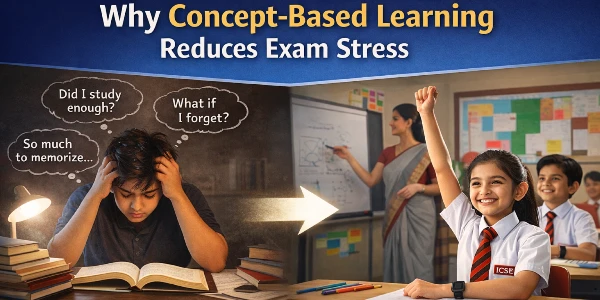
“Did I study enough?”
“What if the questions are different?”
“What if I forget everything?”
This anxiety doesn’t begin the night before the exam. It begins months earlier — when learning becomes memorisation instead of understanding.
Concept-based learning quietly changes this entire experience. It reshapes how students prepare, how they revise, and most importantly, how they feel about exams.
The Difference Between Studying and Understanding
Two students prepare for the same exam.
One memorises answers repeatedly.
The other understands how ideas connect.
On exam day, the first student hopes the question appears exactly as practised.
The second student adapts easily because the foundation is clear.
That is the power of conceptual clarity.
Parents searching for “how to reduce exam anxiety in children” or “stress-free ICSE schools in Hyderabad” are often looking for this exact shift — from fear-driven preparation to confidence-driven learning.
Stress Comes From Uncertainty, Not From Exams
Exams themselves are structured and predictable. The syllabus is defined, timelines are known, and preparation time is available.
What creates stress is uncertainty about comprehension.
When students memorise information without truly understanding it, even a slight variation in question format can trigger panic. They begin doubting themselves, even if they studied for hours.
But when they understand the core principle:
They interpret unfamiliar questions confidently
They apply logic rather than memory
They recover quickly from tricky sections
Clarity reduces uncertainty.
Uncertainty reduces stress.
A Small but Powerful Shift in the Classroom
In traditional classrooms, students are often asked:
“Have you completed the chapter?”
In concept-focused classrooms, they are asked:
“Can you explain this in your own words?”
That shift changes everything.
In structured ICSE learning environments:
Students are encouraged to ask “why”
Teachers connect topics to real-life examples
Mistakes are treated as stepping stones
Discussions replace silent memorisation
When students feel safe to think aloud and explore answers, they build intellectual confidence.
And intellectual confidence naturally reduces exam pressure.
Why ICSE Curriculum Supports Conceptual Strength
The ICSE syllabus is known for its depth and application-oriented questions. Parents often search for “ICSE board exam preparation in Hyderabad” or “concept-based learning schools near L.B. Nagar” because the board itself promotes analytical thinking.
ICSE assessments focus on:
Application-based problem solving
Structured descriptive answers
Case-based scenarios
Continuous internal evaluation
This ensures that students are consistently engaging with the material, rather than cramming before final exams.
Regular exposure to structured assessment makes evaluation feel normal — not frightening.
When Learning Makes Sense, Revision Feels Lighter
Students who understand concepts revise differently.
They revisit frameworks, not paragraphs.
They solve variations of problems, not repeat the same example.
They identify weak areas calmly instead of feeling overwhelmed.
Revision becomes reinforcement, not rescue.
And something subtle changes too — students begin to trust their preparation.
That trust is what lowers stress levels significantly.
The Science Behind Conceptual Learning and Calm Performance
When learning is conceptual, the brain organises information in patterns and relationships. This reduces cognitive overload during exams.
Under pressure, the brain retrieves structured information more easily than memorised fragments.
As a result:
Recall becomes faster
Answer framing becomes clearer
Emotional stability improves
Panic reduces
This explains why students trained in conceptual clarity often perform more consistently across subjects like Mathematics, Science, and Social Studies.
Signs That Concept-Based Learning Is Working
Parents may observe small but meaningful indicators:
Their child explains topics confidently without reading notes
They attempt higher-order questions willingly
They manage time effectively during mock tests
They show less emotional distress before assessments
These behaviours signal mastery — not just preparation.
Memorisation Cracks Under Pressure
Rote learning creates fragile confidence.
One forgotten line can disrupt an entire answer. One unexpected question can shake preparation.
But conceptual learners reconstruct answers logically. Even if they don’t remember exact wording, they understand the idea deeply enough to rebuild it.
This flexibility builds academic resilience — an essential skill not just for board exams but for life.
Beyond Marks: Building Long-Term Academic Strength
Concept-based education doesn’t only reduce exam stress — it strengthens long-term performance.
Students trained in understanding:
Develop sharper analytical skills
Adapt better to competitive exams
Transition smoothly into higher secondary studies
Think independently
Education becomes less about survival and more about growth.
The Role of School Environment
Conceptual clarity requires thoughtful teaching.
In ICSE schools that prioritise structured understanding, teachers guide students step by step, encourage discussion, and provide constructive feedback. Continuous evaluation ensures that learning gaps are addressed early.
At Johnson Grammar School, L.B. Nagar and Kuntloor, Hyderabad, the ICSE curriculum is delivered with an emphasis on conceptual depth and steady academic development. Through interactive classroom discussions, analytical teaching methods, and balanced assessments, students develop clarity rather than confusion.
When clarity increases, confidence follows.
And when confidence grows, exam stress naturally reduces.
Conclusion: Calm Is the Result of Clarity
Exam stress is not an unavoidable part of education.
It is often the result of surface learning.
Concept-based learning replaces fear with understanding, uncertainty with structure, and pressure with preparedness.
When students truly understand what they learn, exams stop feeling like threats — they become opportunities to demonstrate growth.
And that shift makes all the difference.